Throughout the history of the state there have always been ones who oppose the states, who are generally referred to as Anarchists. Anarchists come in all shapes and forms, from Anarcho-Communists to Autarchists. However, they believe in one goal; The abolishment of the state as we know it and complete freedom for the individual. While I could take at extreme lengths as to to my problems with Anarchism, I will mainly focus on one I foudn rather paradoxical, Agorism.
Agorism is, from what I know, a theory that everyone should use the black market in an attempt to bring about a free market economy. And, the black market is a perfect example of an Anarchistic Free Market, no government taxation, no government regulations, complete control over ones business, etc. (I was going to insert a jab about gangs but decided not to).
However, for Agorism to come about, we need a couple of pre-conditions:
- That the Black Market is substantial enough to cater for the needs of the consumers (Which will be, in the case of Agorism, the entire population).
- All relevant Taxation is so high that it acts as an incentive to buy off the cheaper black market.
- The government will not take action to the point of curbing the trade in the black market, and will not reduce it in anyway.
- The Black Market is convenient to access but safe enough to not be caught buying\ selling in.
- That pre-existing companies and corporations will not profiteer from the black market, thus bringing about their ruin.
- The product or service received must be of similiar or higher quality, and if not, can only be so poor to the point it justifies its lower cost.
This may seem like a very hefty set of pre-conditions, and indeed it is hard to compare it to any examples, seeign as outlawed products\services that are outlawed lack any form of sales tax to start with and can only be obtained through the black market, and any legal products and services rarely have a substantial black market. However, let's consider one: Unregistered Taxis. These, mostly foreign, cabbies are unwillingly becoming a show case of Agorism in action. These illegal taxis tick most of the boxes, the taxes are an incentive, the market is pretty easy to access (You need a car), taxis are mainly run by one man so companies don't arise or ply their hand in the market, and the government find it hard to clamp down an illegal taxis. The only issue is taxis aren't substantial enough to cater to everyone. Anarchists aren't going to wait an hour or two so they can get an illegal cab (And, what cabby will admit as much anyway?), if such a cab was to come. Taxis aren't substantial enough to cater everyones needs, or at least the agorists needs.And this isn't uncommon. The black market is often small, fractured and generally ineffecient,.
Of course, the only way of increasing illegal taxis, or any product\service for that matter, is through, quite ironically, increasing government regulation and taxation of that product\service. Essentially, the only way for anarchism to come about through Agorism is that the government needs to simply implement extremely statist and authoritarian policies to kick start an anarchist policy. This is the paradox of Agorism, Agorism is fuelled by Statism. Despite Agorists being freedom loving anarchists, which one of them will honestly look you in the eyes and tell you they support drug legalisation and believe women should be allowed receive abortions by medical professionals when both these things are handled by the black market. Well, not exactly for abortions, which leads me to my next part of this rant.
When it comes to products in the black market, many of them are unsafe. A rather extreme exampel would be abortions. The coat hangar abortion is nowhere near as safe as the one performed in hospitals. Indeed, back alley abortions would be a prime example against a black market, though I'm guessing Agorists see it as the last service to be "Agorised", which would require a mass movement of medical professionals to the black market. However, consider all the products, particularly food products, which would go without being checked for harmful defects. Of course, Agorist, and Anarchists and Libertarians in general, will argue that consumers should be fully aware that food may make them sick and shoudl take any protective measures into their own hands. While I find reason within both statements, I think the idea that a protective agency will arise in a small black market is just a silly, idealistic notion.
Essentially, I see the merit of Agorism, that true free market can arise through the use of the black market over the government sanctioned market. However, I think Agorists forget the power of the government and the corporations, who combined can do serious damage to the black market. The reason they haven't done so is because the black market hasn't been big enough to warrant this, and in nations with big black markets business and government are often corrupt and weak to do anything, and indeed most business operates within the black market.
Many Agorists would argue that to reduce regulation (Which would be a bad thing for the balck market) would be positive for the anarchistic end goal, however, that's not agorism, that's anarchism through government, another paradox.
My conclusion is that Agorism is a paradox in it's implementation, that to be successful it would need to suppress freedom and implement lots of ridiculous regulations. And this would be contradictory to everything Anarchism stands for. not only this, but it is impractical in the "switch-over" and for me, leads a lot of questions in hypothetical and plausible areas,
Friday, August 27, 2010

Saturday, August 14, 2010
Third Gulf War?
The Middle East, throughout time, has been a place of attention. That starting place of 3 Major World Religions, the site of all of the worlds crusades, a key point in the connection between Europe and the Far East, a vital trade route, and more recently, a hotbed of terrorism, war, religious extremism, and quite inconveniently, the place with the worlds largest oil reserves. Regional conflicts in the region since WW2 aren't uncommon, the various wars with Israel and her neighbours, the Iran-Iraq war, the First and second gulf wars, and the various revolutions. And now, we could be geared up for another one, involving two of the regions most controversial states, Iran and Israel.
Now, I'm generally wary of speculative reports of anything based on trends, but the G-8 and even Israel themselves admit a war between Israel and Iran is likely. With this in mind, I think it's a fair assumption to say Israel is going to attack Iran on the basis of it's nuclear weapons program. Now, there are two basic strategies here, long term and short term:
Long term: Provoke Iran and get Saudi Arabia dragged in, which will get the US dragged in. If an invasion of Iran by land occurs, then it will become long-term, and the US and its allies can destroy any Iranian nuclear stations.
Short term: Israel bombs any station it can get at, which will mostly be in the West and South. This will destroy some bases and impede some progress but will in the big picture do little damage.
Long term is for the US an unrealistic option. They are already footing the bill for two wars and are trying to recover negative domestic and international opinion for it's "imperialist" policies. As well as that it's military is stretched as it stands. However, in the short term, little will be done besides impede their progress, but it will send the right message to Iran, and other rogue nations such as North Korea, that a response will be given if you try and develop nuclear weapons. Of course, the alternative is Iran gets international sympathy from an entrenched Pro-Palestine European Left, and speeds up it's nuclear program.
What Iran will do domestically in response to such attacks is another question. The attacks could spark nation wide protests from an already angered pro-democracy Iranians, but despite what the West thinks, Ahmadinejad is popular in Iran, as he appeals to the religious, conservative right through his hardline Anti-America international policy, but its also popular through his social programs. Any attack will let Ahmadinejad claim the West is attacking poor 'ol Iran, and will enable him to bring any undecided, on the bench moderates to his side in a patriotic appeal for unity to fight aggression.
Of course, all of the above depends on how the war goes down. A fairly accurate simulation by the New York Times can be found here, but it all depends on if each step is successful. However, my theory on a potential war is as follows:
Now, I'm generally wary of speculative reports of anything based on trends, but the G-8 and even Israel themselves admit a war between Israel and Iran is likely. With this in mind, I think it's a fair assumption to say Israel is going to attack Iran on the basis of it's nuclear weapons program. Now, there are two basic strategies here, long term and short term:
Long term: Provoke Iran and get Saudi Arabia dragged in, which will get the US dragged in. If an invasion of Iran by land occurs, then it will become long-term, and the US and its allies can destroy any Iranian nuclear stations.
Short term: Israel bombs any station it can get at, which will mostly be in the West and South. This will destroy some bases and impede some progress but will in the big picture do little damage.
Long term is for the US an unrealistic option. They are already footing the bill for two wars and are trying to recover negative domestic and international opinion for it's "imperialist" policies. As well as that it's military is stretched as it stands. However, in the short term, little will be done besides impede their progress, but it will send the right message to Iran, and other rogue nations such as North Korea, that a response will be given if you try and develop nuclear weapons. Of course, the alternative is Iran gets international sympathy from an entrenched Pro-Palestine European Left, and speeds up it's nuclear program.
What Iran will do domestically in response to such attacks is another question. The attacks could spark nation wide protests from an already angered pro-democracy Iranians, but despite what the West thinks, Ahmadinejad is popular in Iran, as he appeals to the religious, conservative right through his hardline Anti-America international policy, but its also popular through his social programs. Any attack will let Ahmadinejad claim the West is attacking poor 'ol Iran, and will enable him to bring any undecided, on the bench moderates to his side in a patriotic appeal for unity to fight aggression.
Of course, all of the above depends on how the war goes down. A fairly accurate simulation by the New York Times can be found here, but it all depends on if each step is successful. However, my theory on a potential war is as follows:
- Like the article, I believe Israel will attack by bombing Iranian facilities by flying low, but whether or not they will use Saudi Arabia is debatable. While Iraq would be a much more realistic and safer option, the US would not allow Israel to land there without prior notice. Thus, a discreet fly-over and possible landing in the Saudi desert is likely.
- The US will freak out obviously, but like the article, the US will step in to stop the situation from resulting in an all-out Middle Eastern war.It will use the fact there are hundreds of thousands of US and pro-US troops East and West of the Iranian border, and they might be compelled to, y'know, step over the border and start shooting things up. Meanwhile, the fact that Israel gets a huge amount of aid from the US means the US can basically tell them without any military force to stop their attacks unless the US gives the green light first.
- Mahmoud, however, will be very angry, and the ayatollahs will begin pressuring the government to respond to the Zionist threat of Israel. They also dislike the Saudis. Iran will see that 1) Israel used Saudi Arabia to attack, and 2) Will think the US had a hand in these attacks, and will see an attack on the Saudi oil refineries as effective as an attack on the US itself.
- Iran also begins to pander to the international community as a victim of aggression. While China and Russia won't budge, this will mean the European Left will be up in arms with heir usual anti-US, anti-globalism and anti-Israel dogma. European opinion will therefore be split.
- Iran gets Hezbollah and Hamas to begin attacks on Israel. Meanwhile, Iran will attack Saudi oil refineries.
- Israel responds aggressively, as usual, to Hamas and Hezbollah, and in the process begin to move in on Palestine, which will anger the European left even more. Israel will again become a temporary battleground, but Israel will have a no-holds barred attitude. Thousands upon thousands of Israel troops move out against their neighbours.
- Meanwhile ,the Saudis panic and turn to the US for help. The US can't sit back while the Saudis are assaulted, but they can't barge into Iran. The US will probably decide on an immediate embargo on Iran, while attempting to control increased levels of insurgencies in Iraq and Afghanistan.
- The Saudis begin to counter-attack against Iran, while seeking American aid all the way through. The Saudis, more than likely,will bomb Iranian oil facilities in the gulf. The back and forth sends oil prices sky-high
- Israel get the situation more less under control, and the US begins to rally nations such as Russia and China to help with an armistice.
- Saudi Arabia and Iran stop fighting in return for an armistice. Religious conflicts in both countries still remain, and protests in both nations are still widespread.
- The US reinforces troops in the Gulf region and declares itself the saviour of the day.
Friday, August 13, 2010
Aborting Irelands Conservatism
Ireland has never always been on good terms with it's European neighbours. While we are happy with the mass EU investment in Ireland which significantly improved Ireland, and the EU's help in cases involving the UK such as Ireland vs The United Kingdom, where the European Court of Human Rights ruled that the UK had performed inhumane and degrading torture, and violated the European Convention of Human Rights. What annoys Ireland is when Europe breaches it's territory on domestic policy. As an example, a major argument in opposition to the Lisbon Treaty was their ability to interfere with Irish military and abortion policy. Fortunately, this were struck down as untrue (Which they were), but it shows that regardless to anything in that bill, the issue of Ireland losing sovereignty is a major issue to us Irish.
Now, when the case of A, B and C vs. Ireland was brought to the European Court of Human Rights (Which was an abortion case, not alphabet city suing Ireland), people naturally got a bit nervous, because A, B and C were women who were suing Ireland for their denial of abortion in Ireland, and having to travel abroad to get one. To draw a parallel, the European Court of Human Rights (Which from here on in will be known as the ECHR) ruling in favour of A, B and C would be our Roe vs. Wade, and would apply to all Council of Europe nations.
Now, there are two obvious questions here, 1. Why does Ireland care so much about having control of all of it's domestic policies in comparison to its European neighbours and 2. Why is Ireland so uptight about Abortion.
To understand 1, we must travel back about 100 years. Before 1921-22, Ireland didn't have any say in it's laws. All laws were made in the British parliament in Westminister. Despite the fact we had 103-105 seats out of 665 seats, which was more than our fair share of seats, we still didn't have a great amount of influence. Most of our policies were, as we saw it, decided by a foreign government who didn't have our interests at heart. Although the majority of people were in favour of an Ireland-UK union up until some major British mistakes, it was viewed as a dark times and we pride ourselves with our independence over one of the largest empires of all time. We still have that sense of Irish pride over our independence from Britain, and thus aren't willing to submit ourselves in the same way our European brethren are, to the EU and Council of Europe.
Number 2 has a fairly simple explanation, and that's religion. For most of the 20th century the Catholic Churhc had an Iron Grip on Irish affairs. As some say, Ireland was freed from British rule and put under Rome's rule. It was so bad that at one point the Archbishop was consulted on all government decisions, any adult context or content that was deemed anti-religious was banned (Even a novel which mentioned 2 women kissing), movies were regularly banned or censored, homosexuality was outlawed along with contraception and divorce, and priests were allowed get away with child abuse en masse. This gives you an idea of the situation. The Church didn't agree with abortion, and thus it was outlawed.However, the Churchs grip faltered in the 1980's, and was gone by the 1990's. And then Irish laws were liberalised, extremely.
So far Ireland has had 5 referendums on abortion. The Eight Amendment passed in 1983 made abortion illegal except in cases where the womans life was at risk. Amendments twelve, thirteen and fourteen were held on the same day, with all but the former being struck down. Thirteen and fourteen established a womans right to travel abroad for an abortion and to obtain information about abortions, respectively, while twelve would have recognised that suicide was not reasonable grounds to seek an abortion. A failed twenty fifth amendment would have tightened abortion laws, by basically bringing in the field twelfth amendment and putting severe penalties in place for abortion performers.
Of course, the legacy of the Catholic Church is still in place, and abortion is still a controversial topic. Indeed, the government would be more than happy if the CoE (Council of Europe) solved the situation for them and say "Oh, Europe has our backs tied, there's nothing we can do about it!!". The thing abotu abortion is that, besides some extremist groups, people generally don't like to get into discussions abotu it. It's the Voldemort of Irish politics, you just don't say it. And the polls are less than helpful.
The pro-life polls find that 70% of respondents were in favour of constitutional protection for the unborn, 13% opposed and the rest, 16%, undecided. The pro-choice polls by the Irish Family Planning Association found the following:
- Approximately nine out 10 respondents (87%) agreed that termination of pregnancy should be permitted if the pregnancy seriously endangers the woman’s life;
- More than three quarters of respondents (79%) agreed that termination of pregnancy should be permitted if the woman’s health is at risk;
- Nearly eight out of 10 respondents (78%) agreed that termination of pregnancy should be permitted if the pregnancy is the result of sexual abuse / rape or incest;
- Just under two thirds of respondents (62%) agreed that termination of pregnancy should be permitted if there is evidence of a profound foetal abnormality;
- Over four out of 10 respondents (41%) agreed that termination of pregnancy should be permitted if the woman believes it is in her and / or her family's best interest;
- Only three per cent of respondents felt that abortion in Ireland is not acceptable under any circumstances
Depending on what poll you look at, you have a vastly different picture of Irish society. However, I find the pro-choice poll more reliable simply because it was far less ambiguous and made it's questions clearer, as I'm sure most respondents are unaware that Irish Medical Ethics implies Irish doctors cant' perform abortions.While its' safe to say the majority don't believe in an abortion unless there's a legitimate medical reason, the majority obviously favour abortion if there is a valid reason, and furthermore that Irish doctors should be allowed perform them.
Now, the ECHR has a well founded reputation as a secular organisation, bad has ruled in favour of schools banning headscarves and Italy banning crucifixes from classrooms. Should the CoE rule in A, B and C's favour, a referendum still needs to be held. Of course, Ireland doesn't have to abide by the protocol, as it isn't obliged to sign and ratify it. The best Ireland will get out of this is a referendum which will probably be passed. The most likely conclusion of a ruling would be a referendum. Despite what it wants you to think, the Irish government isn't that ballsy when it comes to European matters. It also doesn't need to piss of it's neighbours at the moment, when it needs approval by the EU to get bail-outs.
Of course, this ruling won't be too much of an issue for the CoE. Only 3 members, Ireland, Poland and Germany, don't have abortion available on demand, and the latter two have it available for what the ruling will imply, the right to abortion in their home nation and in cases of fetal defects. It won't be as much of a Roe vs Wade as a ruling confirming what is basically the status quo, and bringing Ireland into line with the modern times.
The law will also solidify the stance of the ECHR on issues such as abortion, that it has a liberal and secular agenda, and will use this as a marker for any nations which wish to be included in Europe. I think such a ruling will further divide the left and right into pro-Europe and anti-Europe respectively. The left will see Europe collectively as a safeguard for rights, while conservatives will see it as a threat to a nation being able to repeal laws.
A ruling is expected some time within 2010, and when it does come, and 99% likely in favour of A, B and C, then it will prompt the Irish left, which has been relatively quiet on such issues. It may also prompt a backlash by the Irish right, which has been far more vocal. Overall, this ruling will only effect Ireland, and will more than likely result in a liberalisation of our laws and more Euroscepticism from the Right.
Now, when the case of A, B and C vs. Ireland was brought to the European Court of Human Rights (Which was an abortion case, not alphabet city suing Ireland), people naturally got a bit nervous, because A, B and C were women who were suing Ireland for their denial of abortion in Ireland, and having to travel abroad to get one. To draw a parallel, the European Court of Human Rights (Which from here on in will be known as the ECHR) ruling in favour of A, B and C would be our Roe vs. Wade, and would apply to all Council of Europe nations.
Now, there are two obvious questions here, 1. Why does Ireland care so much about having control of all of it's domestic policies in comparison to its European neighbours and 2. Why is Ireland so uptight about Abortion.
To understand 1, we must travel back about 100 years. Before 1921-22, Ireland didn't have any say in it's laws. All laws were made in the British parliament in Westminister. Despite the fact we had 103-105 seats out of 665 seats, which was more than our fair share of seats, we still didn't have a great amount of influence. Most of our policies were, as we saw it, decided by a foreign government who didn't have our interests at heart. Although the majority of people were in favour of an Ireland-UK union up until some major British mistakes, it was viewed as a dark times and we pride ourselves with our independence over one of the largest empires of all time. We still have that sense of Irish pride over our independence from Britain, and thus aren't willing to submit ourselves in the same way our European brethren are, to the EU and Council of Europe.
Number 2 has a fairly simple explanation, and that's religion. For most of the 20th century the Catholic Churhc had an Iron Grip on Irish affairs. As some say, Ireland was freed from British rule and put under Rome's rule. It was so bad that at one point the Archbishop was consulted on all government decisions, any adult context or content that was deemed anti-religious was banned (Even a novel which mentioned 2 women kissing), movies were regularly banned or censored, homosexuality was outlawed along with contraception and divorce, and priests were allowed get away with child abuse en masse. This gives you an idea of the situation. The Church didn't agree with abortion, and thus it was outlawed.However, the Churchs grip faltered in the 1980's, and was gone by the 1990's. And then Irish laws were liberalised, extremely.
So far Ireland has had 5 referendums on abortion. The Eight Amendment passed in 1983 made abortion illegal except in cases where the womans life was at risk. Amendments twelve, thirteen and fourteen were held on the same day, with all but the former being struck down. Thirteen and fourteen established a womans right to travel abroad for an abortion and to obtain information about abortions, respectively, while twelve would have recognised that suicide was not reasonable grounds to seek an abortion. A failed twenty fifth amendment would have tightened abortion laws, by basically bringing in the field twelfth amendment and putting severe penalties in place for abortion performers.
 |
| This roughly sums it up |
The pro-life polls find that 70% of respondents were in favour of constitutional protection for the unborn, 13% opposed and the rest, 16%, undecided. The pro-choice polls by the Irish Family Planning Association found the following:
- Approximately nine out 10 respondents (87%) agreed that termination of pregnancy should be permitted if the pregnancy seriously endangers the woman’s life;
- More than three quarters of respondents (79%) agreed that termination of pregnancy should be permitted if the woman’s health is at risk;
- Nearly eight out of 10 respondents (78%) agreed that termination of pregnancy should be permitted if the pregnancy is the result of sexual abuse / rape or incest;
- Just under two thirds of respondents (62%) agreed that termination of pregnancy should be permitted if there is evidence of a profound foetal abnormality;
- Over four out of 10 respondents (41%) agreed that termination of pregnancy should be permitted if the woman believes it is in her and / or her family's best interest;
- Only three per cent of respondents felt that abortion in Ireland is not acceptable under any circumstances
Depending on what poll you look at, you have a vastly different picture of Irish society. However, I find the pro-choice poll more reliable simply because it was far less ambiguous and made it's questions clearer, as I'm sure most respondents are unaware that Irish Medical Ethics implies Irish doctors cant' perform abortions.While its' safe to say the majority don't believe in an abortion unless there's a legitimate medical reason, the majority obviously favour abortion if there is a valid reason, and furthermore that Irish doctors should be allowed perform them.
Now, the ECHR has a well founded reputation as a secular organisation, bad has ruled in favour of schools banning headscarves and Italy banning crucifixes from classrooms. Should the CoE rule in A, B and C's favour, a referendum still needs to be held. Of course, Ireland doesn't have to abide by the protocol, as it isn't obliged to sign and ratify it. The best Ireland will get out of this is a referendum which will probably be passed. The most likely conclusion of a ruling would be a referendum. Despite what it wants you to think, the Irish government isn't that ballsy when it comes to European matters. It also doesn't need to piss of it's neighbours at the moment, when it needs approval by the EU to get bail-outs.
Of course, this ruling won't be too much of an issue for the CoE. Only 3 members, Ireland, Poland and Germany, don't have abortion available on demand, and the latter two have it available for what the ruling will imply, the right to abortion in their home nation and in cases of fetal defects. It won't be as much of a Roe vs Wade as a ruling confirming what is basically the status quo, and bringing Ireland into line with the modern times.
 |
| Blue: Abortion on Demand; Yellow:Legal for rape, maternal life, health, mental health, socioeconomic factors, and/or fetal defects; Brown: Legal for rape, maternal life, health, mental health, and/or fetal defects; Orange: Legal for rape, maternal life, health, and/or mental health: Red: Illegal with exception for maternal life, health, and/or mental health. |
The law will also solidify the stance of the ECHR on issues such as abortion, that it has a liberal and secular agenda, and will use this as a marker for any nations which wish to be included in Europe. I think such a ruling will further divide the left and right into pro-Europe and anti-Europe respectively. The left will see Europe collectively as a safeguard for rights, while conservatives will see it as a threat to a nation being able to repeal laws.
A ruling is expected some time within 2010, and when it does come, and 99% likely in favour of A, B and C, then it will prompt the Irish left, which has been relatively quiet on such issues. It may also prompt a backlash by the Irish right, which has been far more vocal. Overall, this ruling will only effect Ireland, and will more than likely result in a liberalisation of our laws and more Euroscepticism from the Right.
Wednesday, August 11, 2010
The sun rises on the Nuclear Age
On 26 April 1986, Nuclear Energy was dealt it's own Nagasaki and Hiroshima. The meltdown of the Chernobyl power plant and the effects that followed would leave a huge dent in the side of the nuclear energy movement, whilst giving the Anti-Nuclear movement a seemingly indestructible argument against the use of nuclear energy.
Of course, what these anti-nuclear activists constantly fail to forget that Chernobyl was a direct end result of poor worker oversight and outdated nuclear technology.Now, I'm no expert on nuclear technology, but I can (With the help of Wikipedia) sum up why Chernobyl happened in the first place:
- Chernobyls reactor had a dangerously large positive void coefficient. Essentially, this means that neutrons are not slowed down, which makes them likely to split uranium atoms, allowing them to increase the reactors output to dangerous level. Of course, even if former Soviet states which still use these plants, modifications have been made "Before the Chernobyl accident these reactors had a positive void coefficient of 4.7 beta and after the accident that was lowered to 0.7 beta."
- The control rods allowed the reactors output to increase temporarily rather than slow down as intended due to the fact they were made of graphite and boron carbide.
- The RMBK-1000's reactor design was not up to safety standards of the time.
The workers in Chernobyl themselves deviated from very basic guidelines and regulations. "During preparation and testing of the turbine generator under run-down conditions using the auxiliary load, personnel disconnected a series of technical protection systems and breached the most important operational safety provisions for conducting a technical exercise."
Of course, not only are Western power plants much safer and better staffed than Chernobyl ever was, it's important to remember the effects of Chernobyl have often been inflated. The Chernobyl disaster didnt' result in a fallout of epic proportions.
So far 41 people have died directly as a result of the accident. The people who received the highest dosages of radiation were the workers on the clean up teams, or "liquidators". And even the effects of that were limited to genetic mutations in their offspring in the initial months after the explosion, with a sharp decline after the first 10 months, to an almost non-existent effects after 70 months. 700 cases of thyroid cancer in children have been documented, but this is easily treated early on, and there has been no visible increase in leukaemia. Overall, according to Wikipedia, "there is little evidence of increased mortality, cancers or birth defects among them; and when such evidence is present, existence of a causal link to radioactive contamination is uncertain.". The only argument left based on Chernobyl is the effect on the environment, but that's only on the immediateness surrounding area, and measures can be taken to limit the effects of this by shutting off waterways, bulldozing forests, etc.
By virtue of the fact that the effects of Chernobyl aren't what we could describe as disastrous, alarmist responses to a nuclear power plant along the lines of "Chernobyl Number 2!!" are ignorant. While 1 person dying is too much and I do recognise it did damage, a lot of the damage is comparable to that of the recent Gulf Oil Spill, but unlike the Gulf Oil Spill, this was once not multiple times annually, as is the frequency of oil spills.
One of the other frail anti-nuclear arguments include the use of nuclear plants as a high-risk target for a terrorist attack, but they fail to point to a single case of "nuclear terrorism", and there's a bigger chance and more evidence of planes being used rather than a nuclear power station for a terrorist attack.
As for the nuclear waste, most of the waste (90%+) is Low Level waste which are product contaminated in the production of nuclear energy. The rest, High Level waste, is dangerous and can take millions of years to decay, although with the correct storage facilities it is not an issue.
Asides, from all these drawbacks, nuclear energy is the most reliable CO2-Free alternative. As the economist put it:
"nuclear reactors are the one proven way to make carbon-dioxide-free electricity in large and reliable quantities that does not depend (as hydroelectric and geothermal energy do) on the luck of the geographical draw."
The CO2 from Nuclear Energy, as demonstrated in this graph, is minimal, and most is indirect from mining, transportation, refinement, etc.
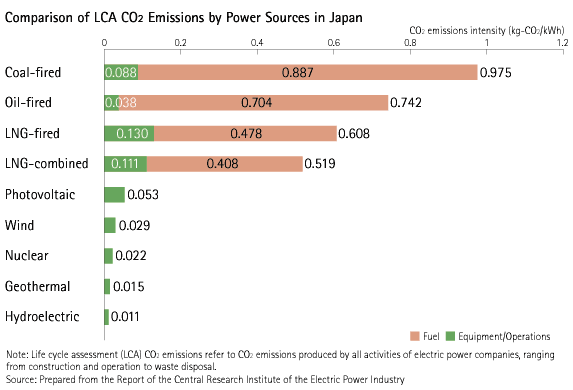
A good case study of the environmental impact of Nuclear energy is France. I will compare it to Italy, it's next-door neighbour which is similar to it in many ways. Italy, however, has no nuclear energy plants, while France has 34 plants which account for 78.8% of their energy needs. Due to the fact France has a slightly bigger population, 65 million as opposed to Italys 60 million, any differences that aren't too large can be contributed to the population difference. Here are some comparable statistics:
Italy, Carbon Dioxide from fossil fuels 2000: 117
France, Carbon Dioxide from fossil fuels 2000: 109
Italy, Carbon Dioxide per Capita: 7
France, Carbon Dioxide per Capita: 6
Italy, CO2 Emissions: 446,596
France, CO2 Emissions: 363,484
Italy, Carbon Efficiency: 0.91 CO2 emissions/$ GDP
France, Carbon Efficiency: 0.78 CO2 emissions/$ GDP
In all cases, France has a significantly lower amount of CO2, which is attributable to their respective energy policies, seeing as both have similar transport systems.
Even if you aren't an adherent to the idea of global warming, nuclear energy provides a clear advantage: Energy independence. Uranium comes from "safe" countries like Canada and Australia, so we won't have a repeat of the 1973 Oil Crisis and won't be as subject to fluctuating oil prices in the normally political unstable Middle East.
Although nuclear energy is not renewable as Uranium is finite, this is only true for Fission Power. Fusion power is a completely different game altogether. Fusion power uses Deuterium , which is found in the Earths oceans and is essentially an infinite source of power. The Sun is an example of Fusion power, which probably demonstrates the problem of fusion - controlling it. The situation is summed up by Physicist Sebastien Balibar "We say that we will put the sun into a box. The idea is pretty. The problem is, we don't know how to make the box"
While I think wind, solar, geothermal, hydro and biomass are more favourable alternatives and that Nuclear energy has it's risks, albeit extremely low ones, I don't think they're useful for all countries. While Solar is useful for nations within the Sahara with vast deserts with no habitation, it certainly can't use Hydro-electric, Biomass, or geothermal. In all cases of these renewable sources, huge investment on power generation which produces little compared to fossil fuels and nuclear is needed, and requires vast amounts of land to produce the same amount of energy. Hydro-electricity often requires whole valleys to be flooded and is subject to precipitation levels and weather. Solar is also only suitable for vast stretches of uninhabited desert, and even then you pay a lot to get that energy back to cities where it's used. Wind requires fields subject to reasonable windy conditions and thus is heavily subject to weather and air mass shifts. As for biomass, you require lots of land and some patience.
Nuclear energy has the environmentally friendly aspect of renewable sources while retaining the convenience of fossil fuel stations. The risks are minimal, and the chances of meltdown are constantly decreasing. The next step of the nuclear age is to develop sustainable fusion energy. Once we reach that, we have truly walked into nuclear age.
 |
| Does Nuclear Energy really mean repeats of Chernobyl en masse? |
- Chernobyls reactor had a dangerously large positive void coefficient. Essentially, this means that neutrons are not slowed down, which makes them likely to split uranium atoms, allowing them to increase the reactors output to dangerous level. Of course, even if former Soviet states which still use these plants, modifications have been made "Before the Chernobyl accident these reactors had a positive void coefficient of 4.7 beta and after the accident that was lowered to 0.7 beta."
- The control rods allowed the reactors output to increase temporarily rather than slow down as intended due to the fact they were made of graphite and boron carbide.
- The RMBK-1000's reactor design was not up to safety standards of the time.
The workers in Chernobyl themselves deviated from very basic guidelines and regulations. "During preparation and testing of the turbine generator under run-down conditions using the auxiliary load, personnel disconnected a series of technical protection systems and breached the most important operational safety provisions for conducting a technical exercise."
Of course, not only are Western power plants much safer and better staffed than Chernobyl ever was, it's important to remember the effects of Chernobyl have often been inflated. The Chernobyl disaster didnt' result in a fallout of epic proportions.
So far 41 people have died directly as a result of the accident. The people who received the highest dosages of radiation were the workers on the clean up teams, or "liquidators". And even the effects of that were limited to genetic mutations in their offspring in the initial months after the explosion, with a sharp decline after the first 10 months, to an almost non-existent effects after 70 months. 700 cases of thyroid cancer in children have been documented, but this is easily treated early on, and there has been no visible increase in leukaemia. Overall, according to Wikipedia, "there is little evidence of increased mortality, cancers or birth defects among them; and when such evidence is present, existence of a causal link to radioactive contamination is uncertain.". The only argument left based on Chernobyl is the effect on the environment, but that's only on the immediateness surrounding area, and measures can be taken to limit the effects of this by shutting off waterways, bulldozing forests, etc.
By virtue of the fact that the effects of Chernobyl aren't what we could describe as disastrous, alarmist responses to a nuclear power plant along the lines of "Chernobyl Number 2!!" are ignorant. While 1 person dying is too much and I do recognise it did damage, a lot of the damage is comparable to that of the recent Gulf Oil Spill, but unlike the Gulf Oil Spill, this was once not multiple times annually, as is the frequency of oil spills.
One of the other frail anti-nuclear arguments include the use of nuclear plants as a high-risk target for a terrorist attack, but they fail to point to a single case of "nuclear terrorism", and there's a bigger chance and more evidence of planes being used rather than a nuclear power station for a terrorist attack.
As for the nuclear waste, most of the waste (90%+) is Low Level waste which are product contaminated in the production of nuclear energy. The rest, High Level waste, is dangerous and can take millions of years to decay, although with the correct storage facilities it is not an issue.
Asides, from all these drawbacks, nuclear energy is the most reliable CO2-Free alternative. As the economist put it:
"nuclear reactors are the one proven way to make carbon-dioxide-free electricity in large and reliable quantities that does not depend (as hydroelectric and geothermal energy do) on the luck of the geographical draw."
The CO2 from Nuclear Energy, as demonstrated in this graph, is minimal, and most is indirect from mining, transportation, refinement, etc.
A good case study of the environmental impact of Nuclear energy is France. I will compare it to Italy, it's next-door neighbour which is similar to it in many ways. Italy, however, has no nuclear energy plants, while France has 34 plants which account for 78.8% of their energy needs. Due to the fact France has a slightly bigger population, 65 million as opposed to Italys 60 million, any differences that aren't too large can be contributed to the population difference. Here are some comparable statistics:
Italy, Carbon Dioxide from fossil fuels 2000: 117
France, Carbon Dioxide from fossil fuels 2000: 109
Italy, Carbon Dioxide per Capita: 7
France, Carbon Dioxide per Capita: 6
Italy, CO2 Emissions: 446,596
France, CO2 Emissions: 363,484
Italy, Carbon Efficiency: 0.91 CO2 emissions/$ GDP
France, Carbon Efficiency: 0.78 CO2 emissions/$ GDP
Even if you aren't an adherent to the idea of global warming, nuclear energy provides a clear advantage: Energy independence. Uranium comes from "safe" countries like Canada and Australia, so we won't have a repeat of the 1973 Oil Crisis and won't be as subject to fluctuating oil prices in the normally political unstable Middle East.
Although nuclear energy is not renewable as Uranium is finite, this is only true for Fission Power. Fusion power is a completely different game altogether. Fusion power uses Deuterium , which is found in the Earths oceans and is essentially an infinite source of power. The Sun is an example of Fusion power, which probably demonstrates the problem of fusion - controlling it. The situation is summed up by Physicist Sebastien Balibar "We say that we will put the sun into a box. The idea is pretty. The problem is, we don't know how to make the box"
 |
| We have life in a box (of chocolates), a dick in a box, but can we put a Sun in a box? |
While I think wind, solar, geothermal, hydro and biomass are more favourable alternatives and that Nuclear energy has it's risks, albeit extremely low ones, I don't think they're useful for all countries. While Solar is useful for nations within the Sahara with vast deserts with no habitation, it certainly can't use Hydro-electric, Biomass, or geothermal. In all cases of these renewable sources, huge investment on power generation which produces little compared to fossil fuels and nuclear is needed, and requires vast amounts of land to produce the same amount of energy. Hydro-electricity often requires whole valleys to be flooded and is subject to precipitation levels and weather. Solar is also only suitable for vast stretches of uninhabited desert, and even then you pay a lot to get that energy back to cities where it's used. Wind requires fields subject to reasonable windy conditions and thus is heavily subject to weather and air mass shifts. As for biomass, you require lots of land and some patience.
Nuclear energy has the environmentally friendly aspect of renewable sources while retaining the convenience of fossil fuel stations. The risks are minimal, and the chances of meltdown are constantly decreasing. The next step of the nuclear age is to develop sustainable fusion energy. Once we reach that, we have truly walked into nuclear age.
Monday, August 9, 2010
A Blazed Trail in Mexico
Mexico has always been in a precarious state when it comes to drugs. Despite the thousands killed annually through the drugs trade, the familys torn apart, corruption of government officials en masse and kleptomaniac drug lords, it is still seen as one of the major industries of Mexico. No matter the economic climate, drugs will always be in demand.
As it stands, oil is responsible for ~40% of Mexicos Government income, but the oil is finite and even Mexicos President, Felipe Calderon admits it'll be gone in 10 years or so, or at least it will be unprofitable to maintain oil operations in the area. After that you have immigrants sending money back home, but that itself is being cut by the recession. You also have a tourism industry, but that's being cut by the recession, as well as the drug-fuelled violence. However, regardless of economic cycles, the drug industry always stays profitable. When times are good, people earn more, and pay more money for better drugs. During harder times, more people are laid off and are more likely to turn to drugs. So, it's a constant win-win for Drug Cartels.
Mexico isn't unique. Many nations, such as Afghanistan, with the same problem display similar characteristics: Near a Rich region\nation willing to buy drugs, high unemployment, and a weak government. All 3 combine into the drug industry dominating the nation. What makes Mexico particularly culpable is the fact it's the only nation with a direct land route from the drug producing nations like Columbia and Honduras to the US, arguably one of the most important drug markets.
Many Mexican politicians are unwilling to tacked the problem, for a variety of reasons. The most obvious would be the fact they are in the back pocket of these cartels, but others exist too. They recognise tackling the drug gangs is a dangerous move with politicians likely targets for assassination, such as the assassination of Rodolfo Torre, a candidate for a governorship in Northern Mexico, who simply promised more security and closer US-Mexico co-operation. But the mere fact these drug cartels are in a position to target candidates who promise true reform, who might be elected, and have simply stated words and not taken them into action, is frightening. While Torre may be a rather public example, it served it's purpose as a deterrent wit ha clear message from the drug barons - "Don't challenge us, We control you.". Other reasons for lack of clampdown on drug gangs would simply mean higher unemployment, even if the employment is illegal, and more upset voters. Lobbying against these drug gangs also means any possible campaign funding from them is gone.
There's a common trend in all these reasons: a personal gain. Mexican politicians aren't unique, most won't put their neck on the line if it means any form of personal loss, including being killed or elected out of office, and many are more than happy to become the obedient pets of the cartels for a price.
So, it should come as a shock to the Mexican political spectrum when President Felipe Caledron announced his intention to open talks about drug legalisation. A week afterwards ex-president Vicente Fox endorsed the plan to legalise and regulate the manufacture, distribution and sale of drugs, and of course taxation of them. He is joined by the other former Mexican president Ernesto Zedillo. However, drug legalisation seems to be an emerging trend in Latin America. Cesar Gaviria, and Fernando Cardoso, former presidents of Colombia and Brazil respectively, have declared the US war on drugs has failed and have pushed for the legalisation of Marijuana. Mexico already has rather liberal drug laws, decriminalising all illegal drugs and allowing up to 500mg and 5 grams of Cocaine and Marijuana respectively for personal use.
The question for Latin American countries is what is a step in the right direction, the liberalisation of drug policies or a further clamp-down on drug use. The latter seems to have in most cases failed miserably, especially in America, where the end result of the War on Drugs has been a surge in the prison population with a crippling cost of $60 Billion annually.
Portugal is a good example of a country with lax drug laws. Personal possession of drugs is legal and drug abusers are targeted for treatment rather than prison. The result, accordion to he Cato institution, has been positive: "illegal drug use by teenagers had declined, the rate of HIV infections among drug users had dropped, deaths related to heroin and similar drugs had been cut by more than half, and the number of people seeking treatment for drug addiction had doubled."
While plausible that this may have positive effects in Mexicos case, the main issue for Mexico is stemming drug related violence, a direct result from the power vacuum left after the arrest of Mexicos most powerful drug lords. The argument for the legalisation of the production, distribution and sale of drugs is simple, and brings a twofold effect: Drug cartels are forced into a legitimate form of business which is taxed, bringing the government revenue (And large revenue given the size of Mexicos drug industry) and stopping drug related violence. While the illegal drug trade won't be completely destroyed, it will be diminished greatly. While the idea of their product being taxed is unfavourable to drug barons, and having to struggle with trade unions and government inspection, the fact they can continue business as usual without the possibility of the government breathing down on their necks and plausibly shutting their business down would be a major relief, and coupled with the fact paying off politicians will no longer be a huge issue, the policy might work, perhaps coupled with a tax incentive for the first few months. Those who choose to remain in the illegal trade will have to deal with Mexican authorities, whose job will be more concentrated, and less corrupted.
A continued Drug War is the only alternative to complete drug legalisation for Mexico short of ignoring the problem and let it consume the nation. Despite America pledging $1.6 Billion of aid under the Merida initiative, a continued War on Drugs is unsustainable. As the Mexican authorities continually intercept drug shipments and arrest cartel members, the violence increases. It is a viscous cycle that the Mexicans are supporting. Incidents like the 2008 Morelia grenade attacks, an attack when two grenades were thrown into a crowded plaza, killing 10 people and injuring 100+, are extreme, but like Rodolfo Torre, they show you what these drug gangs are capable of. When Mexican authorities damage the drug trades reputation through an arrest or interception, the drug gangs respond through terror. It really is a war, but one that Mexico cannot win.
Indeed, this violence has an effect on the US too. The drug cartels mainly aim to supply its US customers. As they resort to higher levels of violence, this spills over to the US border. The US, who seem unwaveringly intent to destroy drugs once and for all, respond to drug dealers, with say, automatic weapons. Drug gangs respond with automatic weapons and hand grenades. The US respond to match this. And on and on the cycle go. The US border is the worst affected area. At the end of the day, the people suffering are the taxpayer and the drug buyer. The taxpayer foots the bill for these extra security measures, and so do drug consumers, who in most cases are middle-working class. In reality the cycle of poverty in which drugs play the role of poverty's catalyst through addiction to drugs, and getting money by any mean to pay for them, and eventual poverty, is being reinforced by the Americans policy.
The solution I propose for thsi situation, and for any country with a Drug-Crime problem (Which is most, I'm guessing), is simple.
- Decriminalise personal possession of drugs
- Decriminalise the production, distribution and purchase\sale of drugs.
- Offer drug therapy, either subsidised or paid by the state.
- Clamp down on the remnants of the illegal drug trade.
- Treat drugs like alcohol and other intoxicants, no use while driving, no public intoxication, etc.
Unfortunately, Americas conservative base will always be of the position drugs are harmful to society (As with prostitution, abortion, and less recently during the '30's, alcohol, oh but not guns, the only one of the above 4 with the intent of harming a live human being), and many moderates, and even liberals, aren't in favour of such a drastic step, and would rather wade in the shallow pool that is the limited legalisation of cannabis.
However, times are looking brighter, with California, a traditionally "Blue" State, and border state, in a position to legalise Marijuana and be the first state to do so, despite polls be in favour of Proposition 19 being struck down by a slim margin (Probably not including potheads blazing in their rooms when the poll was taken) . But it is a glimpse of light in an otherwise dark tunnel.
 |
| Drugs - Profitable whatever the weather! |
As it stands, oil is responsible for ~40% of Mexicos Government income, but the oil is finite and even Mexicos President, Felipe Calderon admits it'll be gone in 10 years or so, or at least it will be unprofitable to maintain oil operations in the area. After that you have immigrants sending money back home, but that itself is being cut by the recession. You also have a tourism industry, but that's being cut by the recession, as well as the drug-fuelled violence. However, regardless of economic cycles, the drug industry always stays profitable. When times are good, people earn more, and pay more money for better drugs. During harder times, more people are laid off and are more likely to turn to drugs. So, it's a constant win-win for Drug Cartels.
Mexico isn't unique. Many nations, such as Afghanistan, with the same problem display similar characteristics: Near a Rich region\nation willing to buy drugs, high unemployment, and a weak government. All 3 combine into the drug industry dominating the nation. What makes Mexico particularly culpable is the fact it's the only nation with a direct land route from the drug producing nations like Columbia and Honduras to the US, arguably one of the most important drug markets.
Many Mexican politicians are unwilling to tacked the problem, for a variety of reasons. The most obvious would be the fact they are in the back pocket of these cartels, but others exist too. They recognise tackling the drug gangs is a dangerous move with politicians likely targets for assassination, such as the assassination of Rodolfo Torre, a candidate for a governorship in Northern Mexico, who simply promised more security and closer US-Mexico co-operation. But the mere fact these drug cartels are in a position to target candidates who promise true reform, who might be elected, and have simply stated words and not taken them into action, is frightening. While Torre may be a rather public example, it served it's purpose as a deterrent wit ha clear message from the drug barons - "Don't challenge us, We control you.". Other reasons for lack of clampdown on drug gangs would simply mean higher unemployment, even if the employment is illegal, and more upset voters. Lobbying against these drug gangs also means any possible campaign funding from them is gone.
| Killed for expressing the need for reform. |
There's a common trend in all these reasons: a personal gain. Mexican politicians aren't unique, most won't put their neck on the line if it means any form of personal loss, including being killed or elected out of office, and many are more than happy to become the obedient pets of the cartels for a price.
So, it should come as a shock to the Mexican political spectrum when President Felipe Caledron announced his intention to open talks about drug legalisation. A week afterwards ex-president Vicente Fox endorsed the plan to legalise and regulate the manufacture, distribution and sale of drugs, and of course taxation of them. He is joined by the other former Mexican president Ernesto Zedillo. However, drug legalisation seems to be an emerging trend in Latin America. Cesar Gaviria, and Fernando Cardoso, former presidents of Colombia and Brazil respectively, have declared the US war on drugs has failed and have pushed for the legalisation of Marijuana. Mexico already has rather liberal drug laws, decriminalising all illegal drugs and allowing up to 500mg and 5 grams of Cocaine and Marijuana respectively for personal use.
The question for Latin American countries is what is a step in the right direction, the liberalisation of drug policies or a further clamp-down on drug use. The latter seems to have in most cases failed miserably, especially in America, where the end result of the War on Drugs has been a surge in the prison population with a crippling cost of $60 Billion annually.
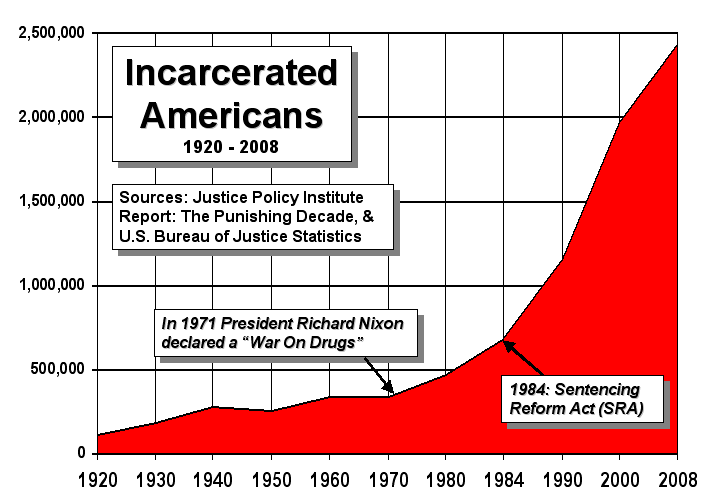 |
| A graph showing the number of prisoners in American prisoners with timeline markers in place. |
While plausible that this may have positive effects in Mexicos case, the main issue for Mexico is stemming drug related violence, a direct result from the power vacuum left after the arrest of Mexicos most powerful drug lords. The argument for the legalisation of the production, distribution and sale of drugs is simple, and brings a twofold effect: Drug cartels are forced into a legitimate form of business which is taxed, bringing the government revenue (And large revenue given the size of Mexicos drug industry) and stopping drug related violence. While the illegal drug trade won't be completely destroyed, it will be diminished greatly. While the idea of their product being taxed is unfavourable to drug barons, and having to struggle with trade unions and government inspection, the fact they can continue business as usual without the possibility of the government breathing down on their necks and plausibly shutting their business down would be a major relief, and coupled with the fact paying off politicians will no longer be a huge issue, the policy might work, perhaps coupled with a tax incentive for the first few months. Those who choose to remain in the illegal trade will have to deal with Mexican authorities, whose job will be more concentrated, and less corrupted.
A continued Drug War is the only alternative to complete drug legalisation for Mexico short of ignoring the problem and let it consume the nation. Despite America pledging $1.6 Billion of aid under the Merida initiative, a continued War on Drugs is unsustainable. As the Mexican authorities continually intercept drug shipments and arrest cartel members, the violence increases. It is a viscous cycle that the Mexicans are supporting. Incidents like the 2008 Morelia grenade attacks, an attack when two grenades were thrown into a crowded plaza, killing 10 people and injuring 100+, are extreme, but like Rodolfo Torre, they show you what these drug gangs are capable of. When Mexican authorities damage the drug trades reputation through an arrest or interception, the drug gangs respond through terror. It really is a war, but one that Mexico cannot win.
 |
| Heavily armed Mexican troops at a random checkpoint |
Indeed, this violence has an effect on the US too. The drug cartels mainly aim to supply its US customers. As they resort to higher levels of violence, this spills over to the US border. The US, who seem unwaveringly intent to destroy drugs once and for all, respond to drug dealers, with say, automatic weapons. Drug gangs respond with automatic weapons and hand grenades. The US respond to match this. And on and on the cycle go. The US border is the worst affected area. At the end of the day, the people suffering are the taxpayer and the drug buyer. The taxpayer foots the bill for these extra security measures, and so do drug consumers, who in most cases are middle-working class. In reality the cycle of poverty in which drugs play the role of poverty's catalyst through addiction to drugs, and getting money by any mean to pay for them, and eventual poverty, is being reinforced by the Americans policy.
The solution I propose for thsi situation, and for any country with a Drug-Crime problem (Which is most, I'm guessing), is simple.
- Decriminalise personal possession of drugs
- Decriminalise the production, distribution and purchase\sale of drugs.
- Offer drug therapy, either subsidised or paid by the state.
- Clamp down on the remnants of the illegal drug trade.
- Treat drugs like alcohol and other intoxicants, no use while driving, no public intoxication, etc.
Unfortunately, Americas conservative base will always be of the position drugs are harmful to society (As with prostitution, abortion, and less recently during the '30's, alcohol, oh but not guns, the only one of the above 4 with the intent of harming a live human being), and many moderates, and even liberals, aren't in favour of such a drastic step, and would rather wade in the shallow pool that is the limited legalisation of cannabis.
 | |
| A cartoon portraying the US-Mexico drug relationship |
However, times are looking brighter, with California, a traditionally "Blue" State, and border state, in a position to legalise Marijuana and be the first state to do so, despite polls be in favour of Proposition 19 being struck down by a slim margin (Probably not including potheads blazing in their rooms when the poll was taken) . But it is a glimpse of light in an otherwise dark tunnel.
Welcome
Welcome to my blog. If you've come on this due to my excessive spamming of the link on Debate.org, then you'll know me. If you've stumbled across this randomly, then a brief background: I'm a teenager from Ireland who's interested in politics, and holds a mixture of liberal and libertarian views.
In this blog I intend to discuss politics, theories, and politics in the world as they are happening, and purely my theory on them, and justification for said theory. I may also delve into religious topics, and generally any topic which is debated.
Well, this it for the time being. I'll possibly have a a new post up by later today.
 | |
| My Political Compass |
In this blog I intend to discuss politics, theories, and politics in the world as they are happening, and purely my theory on them, and justification for said theory. I may also delve into religious topics, and generally any topic which is debated.
Well, this it for the time being. I'll possibly have a a new post up by later today.
Subscribe to:
Posts (Atom)