 |
| Drugs - Profitable whatever the weather! |
As it stands, oil is responsible for ~40% of Mexicos Government income, but the oil is finite and even Mexicos President, Felipe Calderon admits it'll be gone in 10 years or so, or at least it will be unprofitable to maintain oil operations in the area. After that you have immigrants sending money back home, but that itself is being cut by the recession. You also have a tourism industry, but that's being cut by the recession, as well as the drug-fuelled violence. However, regardless of economic cycles, the drug industry always stays profitable. When times are good, people earn more, and pay more money for better drugs. During harder times, more people are laid off and are more likely to turn to drugs. So, it's a constant win-win for Drug Cartels.
Mexico isn't unique. Many nations, such as Afghanistan, with the same problem display similar characteristics: Near a Rich region\nation willing to buy drugs, high unemployment, and a weak government. All 3 combine into the drug industry dominating the nation. What makes Mexico particularly culpable is the fact it's the only nation with a direct land route from the drug producing nations like Columbia and Honduras to the US, arguably one of the most important drug markets.
Many Mexican politicians are unwilling to tacked the problem, for a variety of reasons. The most obvious would be the fact they are in the back pocket of these cartels, but others exist too. They recognise tackling the drug gangs is a dangerous move with politicians likely targets for assassination, such as the assassination of Rodolfo Torre, a candidate for a governorship in Northern Mexico, who simply promised more security and closer US-Mexico co-operation. But the mere fact these drug cartels are in a position to target candidates who promise true reform, who might be elected, and have simply stated words and not taken them into action, is frightening. While Torre may be a rather public example, it served it's purpose as a deterrent wit ha clear message from the drug barons - "Don't challenge us, We control you.". Other reasons for lack of clampdown on drug gangs would simply mean higher unemployment, even if the employment is illegal, and more upset voters. Lobbying against these drug gangs also means any possible campaign funding from them is gone.
| Killed for expressing the need for reform. |
There's a common trend in all these reasons: a personal gain. Mexican politicians aren't unique, most won't put their neck on the line if it means any form of personal loss, including being killed or elected out of office, and many are more than happy to become the obedient pets of the cartels for a price.
So, it should come as a shock to the Mexican political spectrum when President Felipe Caledron announced his intention to open talks about drug legalisation. A week afterwards ex-president Vicente Fox endorsed the plan to legalise and regulate the manufacture, distribution and sale of drugs, and of course taxation of them. He is joined by the other former Mexican president Ernesto Zedillo. However, drug legalisation seems to be an emerging trend in Latin America. Cesar Gaviria, and Fernando Cardoso, former presidents of Colombia and Brazil respectively, have declared the US war on drugs has failed and have pushed for the legalisation of Marijuana. Mexico already has rather liberal drug laws, decriminalising all illegal drugs and allowing up to 500mg and 5 grams of Cocaine and Marijuana respectively for personal use.
The question for Latin American countries is what is a step in the right direction, the liberalisation of drug policies or a further clamp-down on drug use. The latter seems to have in most cases failed miserably, especially in America, where the end result of the War on Drugs has been a surge in the prison population with a crippling cost of $60 Billion annually.
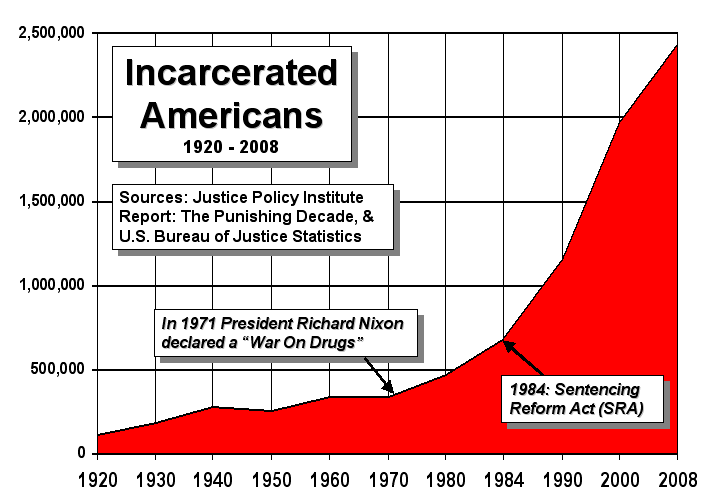 |
| A graph showing the number of prisoners in American prisoners with timeline markers in place. |
While plausible that this may have positive effects in Mexicos case, the main issue for Mexico is stemming drug related violence, a direct result from the power vacuum left after the arrest of Mexicos most powerful drug lords. The argument for the legalisation of the production, distribution and sale of drugs is simple, and brings a twofold effect: Drug cartels are forced into a legitimate form of business which is taxed, bringing the government revenue (And large revenue given the size of Mexicos drug industry) and stopping drug related violence. While the illegal drug trade won't be completely destroyed, it will be diminished greatly. While the idea of their product being taxed is unfavourable to drug barons, and having to struggle with trade unions and government inspection, the fact they can continue business as usual without the possibility of the government breathing down on their necks and plausibly shutting their business down would be a major relief, and coupled with the fact paying off politicians will no longer be a huge issue, the policy might work, perhaps coupled with a tax incentive for the first few months. Those who choose to remain in the illegal trade will have to deal with Mexican authorities, whose job will be more concentrated, and less corrupted.
A continued Drug War is the only alternative to complete drug legalisation for Mexico short of ignoring the problem and let it consume the nation. Despite America pledging $1.6 Billion of aid under the Merida initiative, a continued War on Drugs is unsustainable. As the Mexican authorities continually intercept drug shipments and arrest cartel members, the violence increases. It is a viscous cycle that the Mexicans are supporting. Incidents like the 2008 Morelia grenade attacks, an attack when two grenades were thrown into a crowded plaza, killing 10 people and injuring 100+, are extreme, but like Rodolfo Torre, they show you what these drug gangs are capable of. When Mexican authorities damage the drug trades reputation through an arrest or interception, the drug gangs respond through terror. It really is a war, but one that Mexico cannot win.
 |
| Heavily armed Mexican troops at a random checkpoint |
Indeed, this violence has an effect on the US too. The drug cartels mainly aim to supply its US customers. As they resort to higher levels of violence, this spills over to the US border. The US, who seem unwaveringly intent to destroy drugs once and for all, respond to drug dealers, with say, automatic weapons. Drug gangs respond with automatic weapons and hand grenades. The US respond to match this. And on and on the cycle go. The US border is the worst affected area. At the end of the day, the people suffering are the taxpayer and the drug buyer. The taxpayer foots the bill for these extra security measures, and so do drug consumers, who in most cases are middle-working class. In reality the cycle of poverty in which drugs play the role of poverty's catalyst through addiction to drugs, and getting money by any mean to pay for them, and eventual poverty, is being reinforced by the Americans policy.
The solution I propose for thsi situation, and for any country with a Drug-Crime problem (Which is most, I'm guessing), is simple.
- Decriminalise personal possession of drugs
- Decriminalise the production, distribution and purchase\sale of drugs.
- Offer drug therapy, either subsidised or paid by the state.
- Clamp down on the remnants of the illegal drug trade.
- Treat drugs like alcohol and other intoxicants, no use while driving, no public intoxication, etc.
Unfortunately, Americas conservative base will always be of the position drugs are harmful to society (As with prostitution, abortion, and less recently during the '30's, alcohol, oh but not guns, the only one of the above 4 with the intent of harming a live human being), and many moderates, and even liberals, aren't in favour of such a drastic step, and would rather wade in the shallow pool that is the limited legalisation of cannabis.
 | |
| A cartoon portraying the US-Mexico drug relationship |
However, times are looking brighter, with California, a traditionally "Blue" State, and border state, in a position to legalise Marijuana and be the first state to do so, despite polls be in favour of Proposition 19 being struck down by a slim margin (Probably not including potheads blazing in their rooms when the poll was taken) . But it is a glimpse of light in an otherwise dark tunnel.

No comments:
Post a Comment