 |
| Does Nuclear Energy really mean repeats of Chernobyl en masse? |
- Chernobyls reactor had a dangerously large positive void coefficient. Essentially, this means that neutrons are not slowed down, which makes them likely to split uranium atoms, allowing them to increase the reactors output to dangerous level. Of course, even if former Soviet states which still use these plants, modifications have been made "Before the Chernobyl accident these reactors had a positive void coefficient of 4.7 beta and after the accident that was lowered to 0.7 beta."
- The control rods allowed the reactors output to increase temporarily rather than slow down as intended due to the fact they were made of graphite and boron carbide.
- The RMBK-1000's reactor design was not up to safety standards of the time.
The workers in Chernobyl themselves deviated from very basic guidelines and regulations. "During preparation and testing of the turbine generator under run-down conditions using the auxiliary load, personnel disconnected a series of technical protection systems and breached the most important operational safety provisions for conducting a technical exercise."
Of course, not only are Western power plants much safer and better staffed than Chernobyl ever was, it's important to remember the effects of Chernobyl have often been inflated. The Chernobyl disaster didnt' result in a fallout of epic proportions.
So far 41 people have died directly as a result of the accident. The people who received the highest dosages of radiation were the workers on the clean up teams, or "liquidators". And even the effects of that were limited to genetic mutations in their offspring in the initial months after the explosion, with a sharp decline after the first 10 months, to an almost non-existent effects after 70 months. 700 cases of thyroid cancer in children have been documented, but this is easily treated early on, and there has been no visible increase in leukaemia. Overall, according to Wikipedia, "there is little evidence of increased mortality, cancers or birth defects among them; and when such evidence is present, existence of a causal link to radioactive contamination is uncertain.". The only argument left based on Chernobyl is the effect on the environment, but that's only on the immediateness surrounding area, and measures can be taken to limit the effects of this by shutting off waterways, bulldozing forests, etc.
By virtue of the fact that the effects of Chernobyl aren't what we could describe as disastrous, alarmist responses to a nuclear power plant along the lines of "Chernobyl Number 2!!" are ignorant. While 1 person dying is too much and I do recognise it did damage, a lot of the damage is comparable to that of the recent Gulf Oil Spill, but unlike the Gulf Oil Spill, this was once not multiple times annually, as is the frequency of oil spills.
One of the other frail anti-nuclear arguments include the use of nuclear plants as a high-risk target for a terrorist attack, but they fail to point to a single case of "nuclear terrorism", and there's a bigger chance and more evidence of planes being used rather than a nuclear power station for a terrorist attack.
As for the nuclear waste, most of the waste (90%+) is Low Level waste which are product contaminated in the production of nuclear energy. The rest, High Level waste, is dangerous and can take millions of years to decay, although with the correct storage facilities it is not an issue.
Asides, from all these drawbacks, nuclear energy is the most reliable CO2-Free alternative. As the economist put it:
"nuclear reactors are the one proven way to make carbon-dioxide-free electricity in large and reliable quantities that does not depend (as hydroelectric and geothermal energy do) on the luck of the geographical draw."
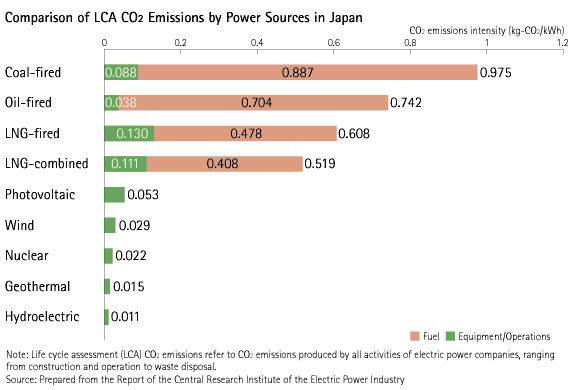
The CO2 from Nuclear Energy, as demonstrated in this graph, is minimal, and most is indirect from mining, transportation, refinement, etc.
A good case study of the environmental impact of Nuclear energy is France. I will compare it to Italy, it's next-door neighbour which is similar to it in many ways. Italy, however, has no nuclear energy plants, while France has 34 plants which account for 78.8% of their energy needs. Due to the fact France has a slightly bigger population, 65 million as opposed to Italys 60 million, any differences that aren't too large can be contributed to the population difference. Here are some comparable statistics:
Italy, Carbon Dioxide from fossil fuels 2000: 117
France, Carbon Dioxide from fossil fuels 2000: 109
Italy, Carbon Dioxide per Capita: 7
France, Carbon Dioxide per Capita: 6
Italy, CO2 Emissions: 446,596
France, CO2 Emissions: 363,484
Italy, Carbon Efficiency: 0.91 CO2 emissions/$ GDP
France, Carbon Efficiency: 0.78 CO2 emissions/$ GDP
Even if you aren't an adherent to the idea of global warming, nuclear energy provides a clear advantage: Energy independence. Uranium comes from "safe" countries like Canada and Australia, so we won't have a repeat of the 1973 Oil Crisis and won't be as subject to fluctuating oil prices in the normally political unstable Middle East.
Although nuclear energy is not renewable as Uranium is finite, this is only true for Fission Power. Fusion power is a completely different game altogether. Fusion power uses Deuterium , which is found in the Earths oceans and is essentially an infinite source of power. The Sun is an example of Fusion power, which probably demonstrates the problem of fusion - controlling it. The situation is summed up by Physicist Sebastien Balibar "We say that we will put the sun into a box. The idea is pretty. The problem is, we don't know how to make the box"
 |
| We have life in a box (of chocolates), a dick in a box, but can we put a Sun in a box? |
While I think wind, solar, geothermal, hydro and biomass are more favourable alternatives and that Nuclear energy has it's risks, albeit extremely low ones, I don't think they're useful for all countries. While Solar is useful for nations within the Sahara with vast deserts with no habitation, it certainly can't use Hydro-electric, Biomass, or geothermal. In all cases of these renewable sources, huge investment on power generation which produces little compared to fossil fuels and nuclear is needed, and requires vast amounts of land to produce the same amount of energy. Hydro-electricity often requires whole valleys to be flooded and is subject to precipitation levels and weather. Solar is also only suitable for vast stretches of uninhabited desert, and even then you pay a lot to get that energy back to cities where it's used. Wind requires fields subject to reasonable windy conditions and thus is heavily subject to weather and air mass shifts. As for biomass, you require lots of land and some patience.
Nuclear energy has the environmentally friendly aspect of renewable sources while retaining the convenience of fossil fuel stations. The risks are minimal, and the chances of meltdown are constantly decreasing. The next step of the nuclear age is to develop sustainable fusion energy. Once we reach that, we have truly walked into nuclear age.

Interesting post, Panda.
ReplyDeleteFyi, here's an Irish politics aggregator: http://www.politicsinireland.com/
Thanks Volkov.
ReplyDelete